Multi-Unit DSCR Loans: Financing 5–8 Unit Properties Without Going Commercial
You've bought a duplex, then a fourplex. Then you find a six-unit that pencils better than anything you've seen — and the lender who financed your last three deals isn't interested. Here's why, and what finances it instead.
Last updated: August 2026
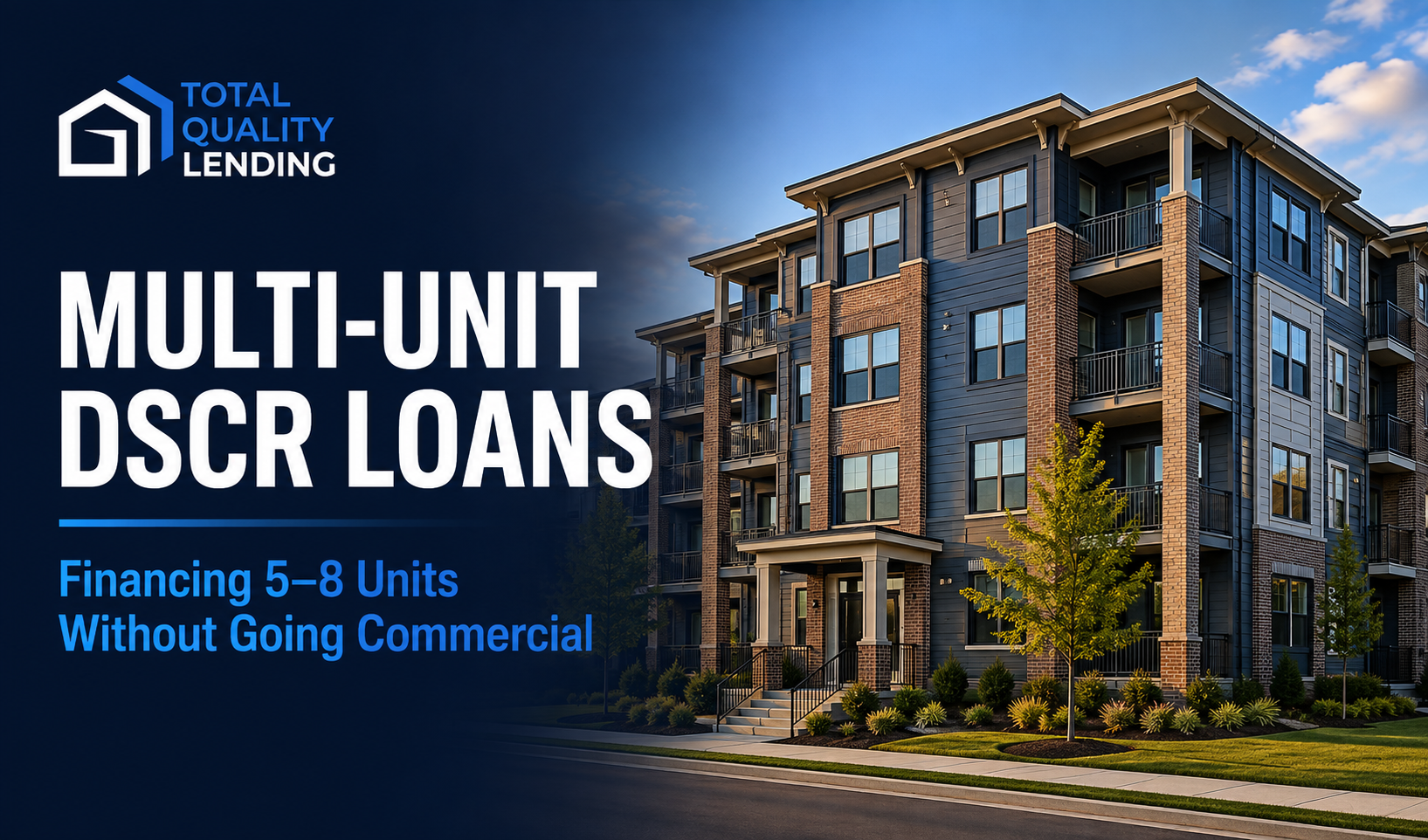
Quick answer: Agency financing stops at four units. At five, a property becomes commercial multifamily — shorter terms, balloon payments, full financial documentation. Multi-Unit DSCR programs bridge that gap, qualifying 5–8 unit residential and 2–8 unit mixed-use properties on rental cash flow instead. Total Quality Lending's program runs up to 75% LTV, credit scores from 700, and loan amounts from $400,000 to $2 million.
There's a specific wall investors hit, and almost nobody sees it coming.
You've bought a duplex. Then a fourplex. The operation works, the financing process is familiar, and you find a six-unit building that pencils better than anything you've looked at in months.
Then the lender who financed your last three deals isn't interested.
The property didn't get riskier. You didn't get less qualified. The building crossed a line that residential lending isn't built to cross.
Where the Four-Unit Limit Comes From
Conventional and agency guidelines define residential as one to four units. At five and above, a property is classified as commercial multifamily — a different category with different underwriting and a different set of lenders.
That distinction is regulatory, not physical. A six-unit and a fourplex on the same street can be nearly identical in construction, tenant profile, and management demands.
The consequences, though, are real:
Shorter terms with balloons. Commercial financing frequently runs five or ten years with a balloon payment, creating refinance risk on a schedule you don't control.
Full financial documentation. Tax returns, global cash flow analysis, personal financial statements — precisely the underwriting most investors moved to DSCR to escape.
Loan size minimums. Many commercial lenders aren't interested below a certain threshold, which makes smaller 5–8 unit buildings awkward to place.
Relationship-based underwriting. Local bank commercial departments often want a deposit relationship and a track record before lending.
None of that is unreasonable from the lender's side. It's just poorly matched to an investor who has been successfully operating small residential rentals and wants to keep doing that with a slightly larger building.
What a Multi-Unit DSCR Loan Does Instead
The program applies residential-style DSCR underwriting to properties in the 5–8 unit range.
Total Quality Lending's Multi-Unit DSCR program:
- 5–8 residential units, or 2–8 unit mixed-use
- Up to 75% LTV
- Credit scores from 700
- Loan amounts $400,000 to $2 million
- Qualification on the property's rental cash flow, not personal income
- Entity vesting available
The qualifying logic matches what you already know from smaller properties: the building's combined rental income measured against its full payment. No tax returns, no personal debt-to-income calculation.
Note the credit requirement is higher than the standard 1–4 unit DSCR program, and the LTV ceiling is lower. That's the trade for keeping residential-style underwriting on a commercial-classified asset.
Running the Numbers on a Small Multifamily
The calculation is the same, applied to the building's total income:
DSCR = Total Monthly Rental Income ÷ Monthly PITIA
A six-unit generating $1,150, $1,150, $1,200, $1,100, $1,175, and $1,225 produces $7,000 in monthly rent. Against a $5,400 payment, that's a DSCR of 1.30.
Two things behave differently at this scale, and both matter more than investors expect.
Vacancy is less dangerous. In a single-family rental, one vacancy means zero income. In a six-unit, one vacancy means roughly 83% of income. That distribution is one of the genuine structural advantages of small multifamily, and it's why a 1.30 on a six-unit is more durable than a 1.30 on a house.
Operating expenses restructure. Some costs improve per-unit — one roof over six units instead of six roofs. Others appear that didn't exist before: common area maintenance, shared utilities, trash service, and in most cases third-party property management rather than self-management. Model the specific building rather than applying single-family percentages.
Mixed-Use: 2–8 Units
The program also covers mixed-use properties from two to eight units — typically residential above commercial ground floor.
These can be strong assets in walkable submarkets, with commercial tenants often signing longer leases than residential ones. They also carry different vacancy dynamics: a vacant retail bay can take considerably longer to fill than an apartment, and the income concentration in a single commercial tenant is a risk worth pricing.
Where Small Multifamily Fits
It tends to suit investors who are:
- Scaling past a handful of single-family rentals and want income concentration rather than more scattered doors
- Comfortable with third-party property management
- Prioritizing cash flow stability over appreciation
- Building toward a portfolio where a single vacancy doesn't disrupt the month
It fits less well for investors who want minimal management involvement, need flexibility to sell individual units, or are buying in a market where small multifamily inventory is thin and priced above what the rents support.
Market fundamentals still drive the outcome — the criteria that make a strong rental market apply to a six-unit exactly as they do to a single-family, with the added consideration that small multifamily demand varies significantly by metro.
How This Fits a Scaling Strategy
Small multifamily usually appears as a step in a sequence rather than a starting point.
An investor recycles capital through BRRRR deals on single-family properties, builds reserves and operating experience, then redeploys into a larger building where income is concentrated and management is more efficient per door.
The financing question at that transition is whether you have to abandon the underwriting approach that made the earlier deals possible. With a multi-unit DSCR structure, you don't.
Frequently Asked Questions
Why can't I use a conventional mortgage on a 5-unit property?
Conventional and agency financing classifies one to four units as residential. At five units and above, a property is considered commercial multifamily, which falls outside conventional guidelines.
What is a multi-unit DSCR loan?
It applies debt service coverage ratio underwriting to properties with five to eight residential units or two to eight mixed-use units, qualifying the borrower on the building's rental income rather than personal income or tax returns.
What credit score is needed for a multi-unit DSCR loan?
Total Quality Lending's Multi-Unit DSCR program requires credit scores from 700, which is higher than the standard 1–4 unit DSCR program.
What are the loan limits on multi-unit DSCR?
Loan amounts run from $400,000 to $2 million, up to 75% LTV.
Does the program cover mixed-use properties?
Yes. Mixed-use properties from two to eight units are eligible under the same program.
Do I need tax returns to finance a 5–8 unit property?
Not with a DSCR-based loan. Qualification is based on the property's rental income relative to the mortgage payment.
Is a 6-unit building riskier than a fourplex?
Not inherently. A larger unit count distributes vacancy risk across more tenants, so a single vacancy affects a smaller share of total income. The differences are mainly in management intensity and expense structure.
Can I hold a small multifamily property in an LLC?
Yes. Entity vesting is available. Formation documents and an operating agreement are typically required during underwriting.
Are short-term rentals allowed on the multi-unit program?
No. Short-term rentals are accommodated under the 1–4 unit DSCR program rather than the 5–8 unit multi-unit program.
Looking at a 5+ Unit Building?
Whether it's your first small multifamily or a refinance on one you already own, send us the property and we'll walk through the numbers and the structure.
Submit a Scenario
https://tqltpo.totalqualitylending.com/submit-scenario
Schedule a Consultation
https://calendly.com/totalquality/investmentconsultation
Built by Originators. Built for Investors.
The Total Quality Lending Team
Total Quality Financial, Inc. | NMLS #1933377. Program guidelines, credit requirements, LTV limits, and loan amounts are subject to change without notice and underwriting approval. This communication is intended for informational and educational purposes only and is not a commitment to lend. Not all applicants will qualify. Equal Housing Lender. For licensing information, visit www.nmlsconsumeraccess.org.