Top 10 Cities to Invest in Real Estate in 2026: Where Smart Investors Are Putting Their Money
The best real estate investment markets in 2026 are not where most investors are looking. Here are the top 10 cities ranked by cash flow, appreciation, and short-term rental potential, with current rental yield data and financing options for each.
The real estate market has shifted significantly over the past two years.
The Sun Belt boom that defined investment activity from 2020 to 2023 has cooled in many markets. Oversupply from aggressive new development has pushed vacancy rates higher and put downward pressure on rents in cities that once seemed unstoppable. Meanwhile, a different set of markets, many of them overlooked for years, has quietly emerged as the strongest investment environment in the country.
The Midwest is pulling ahead of Sun Belt markets in rental demand, with 11 of the top 30 most in-demand rental cities now located in the region. Affordability, supply constraints, and stable employment are driving that shift, and the investors who recognize it early are positioning themselves for durable returns while others are still chasing yesterday's headlines.
This guide covers the ten cities that present the strongest investment fundamentals in 2026, organized by investment strategy, backed by current market data, and written to help investors match the right market to their specific goals.
How to Use This Guide
Not every market is right for every investor. The ten cities below are organized into three categories based on what they deliver best.
Cash Flow Markets are cities where the rent-to-price ratio supports strong monthly income from day one. Entry prices are affordable, rental demand is high, and the numbers work without relying on appreciation to justify the investment.
Balanced Markets are cities that offer a combination of solid cash flow and meaningful appreciation potential. These markets attract investors who want income now and equity growth over time.
Appreciation and Growth Markets are cities where population growth, job creation, and demand fundamentals are strong enough that long-term appreciation is a significant part of the return thesis. Cash flow may be thinner but the long-term wealth-building potential is substantial.
For most investors building substantial portfolios, a diversified approach works best: 40 to 50 percent in cash flow markets for stable income, 30 to 40 percent in balanced growth markets, and the remainder in higher-growth opportunities with longer time horizons.
Cash Flow Markets
Cleveland, Ohio
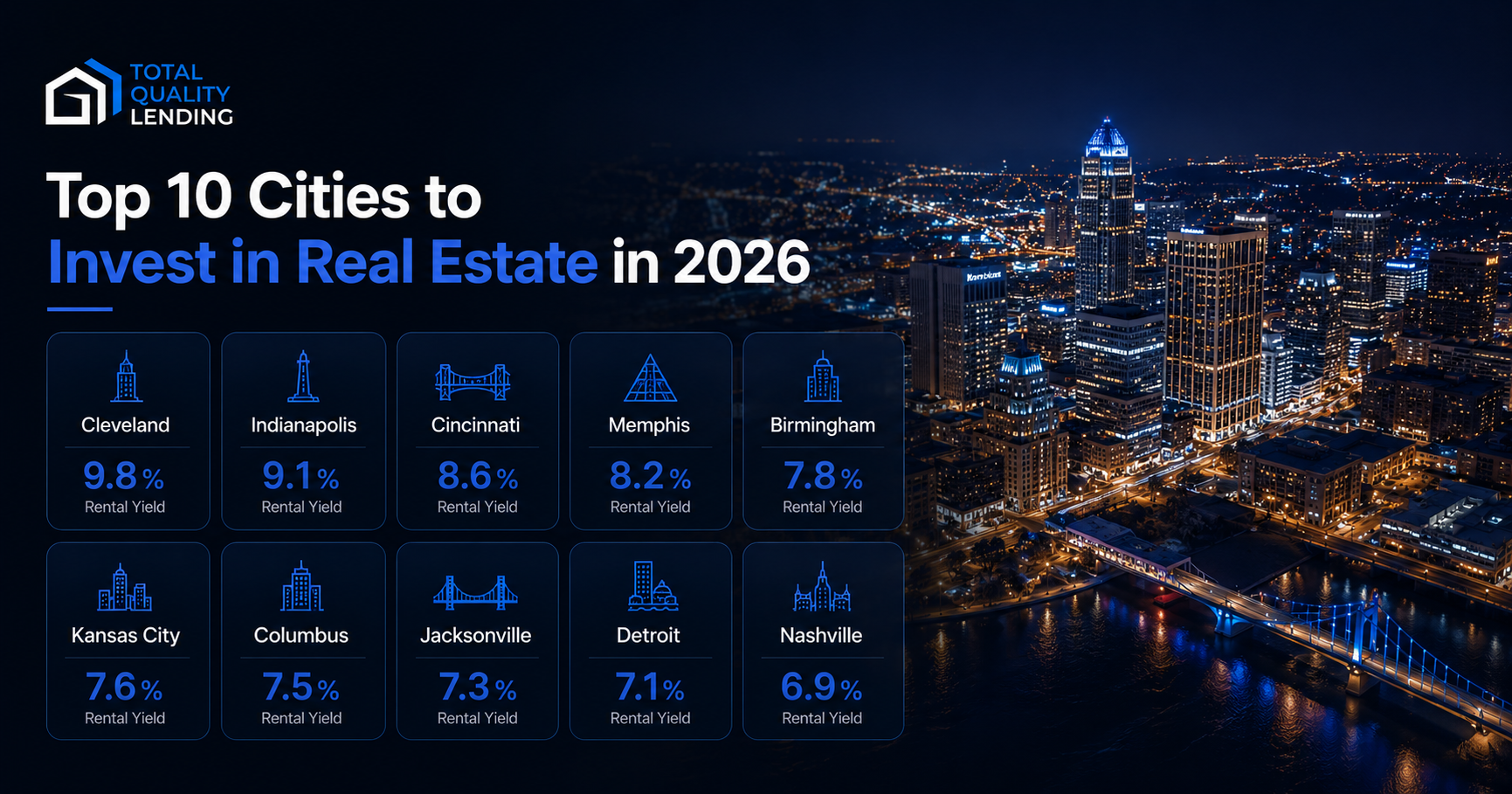
Cleveland leads all major metros with an average rental yield of 9.8 to 11.3 percent, with entry-level home prices still around $110,000. For investors whose primary goal is maximizing the income produced per dollar of capital invested, Cleveland is the strongest major market in the country by that metric in 2026.
The healthcare sector provides stable employment and demand for workforce housing through Cleveland Clinic, University Hospitals, and MetroHealth. Cuyahoga County ranked among the top three counties in Attom's 2025 rankings for buying single-family rentals, with a median sales price of $172,199 and an annual gross rental yield of 10.1 percent. The Cleveland metro area has averaged a 9.01 percent annual home appreciation rate, totaling 136.89 percent over the past 10 years.
The low entry price point means investors can build a multi-property portfolio with significantly less capital than most other markets require. For investors focused on immediate cash flow, Cleveland is consistently the strongest data-supported market available.
Best for: Maximum cash flow, entry-level portfolio building, investors seeking the highest rental yields of any major U.S. metro.
Key metrics: Median home price $110,000 to $175,000 depending on neighborhood. Average rental yield 9.8 to 11.3 percent. Renter-occupied households approximately 59 percent. 10-year appreciation approximately 136 percent.
2. Indianapolis, Indiana
Indianapolis is the most consistently recommended cash flow market in the country for 2026. Zillow named Indianapolis the number one buyer-friendly market for 2026. Rental yields hover around 9.1 percent, and major employers like Eli Lilly continue expanding, creating a consistent stream of people looking for homes.
Average home values in Indianapolis are approximately $229,000, with average rents around $1,374, reflecting roughly 2 percent year-over-year growth. That combination of affordable entry prices and stable rental income produces the rent-to-price ratios that cash flow investors look for and that are increasingly difficult to find in more expensive markets.
Indiana's 2 percent constitutional property tax cap on non-homestead residential property produces one of the most predictable carrying-cost environments in the country, with new deductions beginning in 2026 that provide additional structural improvement for rental property investors.
Indianapolis is also one of the most effective BRRRR markets in the Midwest. The combination of distressed inventory at accessible price points, contractor availability, and strong rental demand post-rehab makes the strategy consistently executable, particularly when paired with a lender who can do cash-out refinance immediately post-rehab without extended seasoning requirements.
Best for: Long-term rentals, BRRRR strategy, portfolio building, first-time investment property buyers.
Key metrics: Median home price approximately $229,000. Average rental yield approximately 9.1 percent. Vacancy rate approximately 4 to 4.3 percent. Appreciation outlook 2 to 4 percent annually.
3. Cincinnati, Ohio
Cincinnati is currently ranked the most in-demand rental market in the United States with a 7.5 percent average rental yield.
Cincinnati's average property price is approximately $125,000, which is 65 percent lower than the national average, with rents averaging $1,200. Over the past ten years, home prices rose by 107 percent, with rents growing by 54 percent. Rent growth of 4.5 percent between May 2024 and May 2025 outpaced comparable Midwest markets including Cleveland, Kansas City, and Pittsburgh.
Cincinnati's diversified economy across healthcare, manufacturing, consumer goods, and financial services provides the employment stability that supports long-term rental demand. The University of Cincinnati and several major healthcare systems create a large, consistent renter population of students, medical professionals, and young workers.
Best for: Cash flow investors, value-add plays, investors seeking strong appreciation alongside high yields.
Key metrics: Average home price approximately $125,000. Average rental yield approximately 7.5 percent. 10-year home price appreciation approximately 107 percent. Rent growth year-over-year approximately 4.5 percent.
4. Memphis, Tennessee
Memphis offers an average rental yield of 7.9 percent with approximately 53 percent of households renting, providing one of the deepest and most reliable tenant pools of any major U.S. city. For investors who want to know their property will stay occupied, Memphis delivers that confidence through sheer renter population density.
Low entry prices make Memphis accessible for investors at earlier stages of portfolio building, and the logistics and healthcare employment base, anchored by FedEx's global headquarters and a major medical district, creates consistent demand across income segments.
Memphis sits at the intersection of affordability, yield, and tenant depth that makes it compelling for investors focused on durable cash flow rather than speculative appreciation. It has consistently appeared across multiple current data sources as one of the top-performing yield markets in the country for 2026.
Best for: Investors prioritizing tenant demand depth, maximum rental yield, and low entry prices in the South.
Key metrics: Average rental yield 7.9 percent. Renter-occupied households approximately 53 percent. Economy anchored by logistics, healthcare, and distribution.
5. Birmingham, Alabama
Birmingham offers some of the highest projected rental yields available in any major U.S. market, with certain properties showing projected returns of 13.6 percent. The median home price is around $180,000 to $251,000 depending on submarket. The University of Alabama at Birmingham is a major economic driver, employing thousands and bringing in students, creating a steady pool of potential renters in healthcare and research fields.
Alabama's property tax structure is among the most investor-friendly in the country. The state assesses residential properties at only 10 percent of market value, which translates directly into lower carrying costs and better net cash flow than comparable yields in other states would produce.
Birmingham rewards investors who do their submarket research. Investors who target properties near UAB, the medical district, and established workforce housing neighborhoods consistently access yield figures that are simply not available in more widely followed markets.
Best for: Maximum yield investors, value-add plays, investors with lower capital requirements.
Key metrics: Average rental yield 7.5 to 13.6 percent depending on property and submarket. Median home price $180,000 to $251,000. Property tax assessment among the lowest in the country at 10 percent of market value.
Balanced Markets
6. Kansas City, Missouri
Kansas City is among the major metros seeing the biggest jump in investor interest for 2026. The market offers stable annual appreciation of 3 to 5 percent alongside a rental yield of approximately 9 percent, making it one of the few markets where both metrics are genuinely strong simultaneously.
Kansas City's central geographic position and diversified economy spanning healthcare, financial services, technology, and logistics provide the kind of employment stability that supports durable rental demand regardless of national economic cycles. Missouri's landlord-friendly environment and property reassessment cycle of every odd year provide additional predictability for investors managing operating costs.
For out-of-state investors specifically, Kansas City consistently ranks as one of the most accessible and manageable markets to invest in remotely. Property management infrastructure is mature, the investor community is active, and the market's size and diversity provide consistent deal flow across multiple neighborhoods and price points.
Best for: Out-of-state investors, balanced cash flow with appreciation, long-term stability seekers.
Key metrics: Average rental yield approximately 9 percent. Appreciation outlook 3 to 5 percent annually. Landlord friendliness excellent with favorable Missouri landlord-tenant law.
7. Columbus, Ohio
Columbus is one of the fastest-growing cities in the Midwest, driven by a young population, Ohio State University's substantial economic footprint, an expanding tech sector, and consistent in-migration from higher-cost metros. Rental yields range from 9 to 11 percent with low vacancy rates, meaning properties are likely to stay occupied consistently.
Columbus stands out for combining strong population growth with Midwest pricing and solid rental yields. The city's diverse economy spanning education, government, technology, and Fortune 500 headquarters provides recession resistance that many comparable markets lack. Neighborhoods surrounding Ohio State's campus offer strong student housing cash flow, while family-oriented suburbs provide long-term appreciation with steady rental income.
For investors who want a market that delivers strong cash flow today while also positioning for meaningful appreciation over a five to ten year hold, Columbus is one of the strongest available options in 2026.
Best for: First-time investors, investors seeking a blend of cash flow and appreciation, portfolio diversification.
Key metrics: Average rental yield 9 to 11 percent. Population growth consistently among the fastest-growing Midwest metros. Vacancy rates low. Economy diversified across education, government, technology, and healthcare.
8. Jacksonville, Florida
Jacksonville offers a gross rental yield of 8.4 percent and a 5-year price appreciation of 49 percent. A median price dip to approximately $302,000 is creating a compelling entry window as demand picks back up, making this one of the few markets where current conditions favor buyers relative to recent history.
Jacksonville is a major port city with a strong logistics and healthcare sector. Unlike South Florida, it offers more affordability and a more stable, less speculative market environment. The population is growing at approximately 1.5 percent annually, and its proximity to the coast without the Miami price tag continues to attract new residents from higher-cost states.
Jacksonville gives investors meaningful Florida exposure, including the demographic tailwinds of in-migration from higher-cost states, no state income tax, and coastal lifestyle appeal, without the speculative pricing and insurance cost challenges that have made other Florida markets more difficult for investors in recent years.
Best for: Balanced investors, single-family rental investors, STR investors seeking Florida exposure without South Florida pricing.
Key metrics: Average rental yield approximately 8.4 percent. 5-year appreciation approximately 49 percent. Population growth approximately 1.5 percent annually. Median price approximately $302,000.
Appreciation and Growth Markets [H2]
9. Detroit, Michigan
Detroit is leading the nation in home appreciation with a 26.8 percent housing market premium, driven by neighborhood revitalization, major corporate investment, and an influx of capital from investors across the country who have identified the opportunity.
Entry-level properties are still available from $75,000 in established neighborhoods, making Detroit one of the most accessible major markets for investors with limited starting capital. Ford's Michigan Central Station investment and ongoing revitalization of neighborhoods like Corktown are driving sustained momentum that is showing up clearly in the appreciation data.
For BRRRR investors, Detroit offers a combination that is rare in 2026: distressed inventory at very low acquisition prices, clear revitalization momentum that supports post-rehab values, and rental demand from a growing workforce population returning to the city. Investors should verify neighborhood-level data from current comparables before underwriting appreciation assumptions, as performance varies significantly by submarket.
Best for: Appreciation-focused investors, BRRRR strategy, investors seeking the lowest entry prices with the highest upside.
Key metrics: Leading the nation in appreciation with a 26.8 percent housing market premium. Entry-level properties from $75,000 in certain neighborhoods. Rental yields among the highest of any major metro.
10. Nashville, Tennessee
Nashville is a lifestyle market that continues to attract in-migration, corporate relocations, and a young, high-income renter population that keeps housing demand elevated. Tennessee's lack of state income tax and business-friendly regulatory environment have made it a destination for corporate relocations across healthcare, technology, and financial services.
Nashville's entertainment and tourism economy supports a meaningful short-term rental market, making it one of the few markets where investors can choose between long-term rental cash flow and STR income from the same property base. For investors considering short-term rental operation, Nashville's strong tourism demand and established Airbnb market provide robust AirDNA data that supports STR income qualification through programs like Total Quality Lending's Investor Hybrid Program.
Nashville is not a cash flow market in the traditional sense. Entry prices have risen significantly and cap rates are thinner than Midwest markets. The investment thesis here is long-term appreciation driven by durable demographic and corporate relocation demand, combined with STR income potential that can significantly improve near-term returns for investors who operate the property effectively.
Best for: Appreciation-focused investors, short-term rental operators, long-term hold strategies.
Key metrics: Strong consistent in-migration supporting long-term appreciation. No state income tax. STR market well-established with robust AirDNA comparable data. Economy anchored by healthcare, technology, entertainment, and tourism.
Markets to Be Cautious About in 2026
Not every market that attracted investor attention in recent years continues to offer the same opportunity.
Several high-growth Sun Belt markets, particularly parts of Austin, Phoenix, and other metros that saw aggressive multifamily development during the pandemic cycle, are experiencing the consequences of supply that significantly outpaced demand growth. Rising vacancy rates, rent concessions, and downward pressure on values characterize these markets in early 2026.
Dallas-Fort Worth, while fundamentally strong over the long term, is experiencing near-term supply pressure in many submarkets that makes it a challenging environment for investors who need immediate cash flow or are underwriting at aggressive rent assumptions. Investors considering Dallas-Fort Worth should model conservative near-term occupancy and rent figures and have the capital reserves to weather an extended stabilization period.
The investors who are winning in 2026 are not chasing the markets that were hot in 2021. They are finding the markets where fundamentals, not momentum, drive the opportunity.
How to Finance Your Investment in Any of These Markets
Finding the right market is the first step. Financing is what makes the acquisition possible.
At Total Quality Lending, we work with real estate investors across the country to structure financing that fits their investment strategy, their target market, and their goals.
Whether you are purchasing a long-term rental in Indianapolis, an Airbnb in Nashville, executing a BRRRR strategy in Cleveland or Detroit, or building a portfolio across multiple Midwest markets, Total Quality Lending has investor loan programs designed for how investment properties actually work.
DSCR loans qualify on property income, not personal tax returns, making them ideal for self-employed investors and portfolio builders. The Investor Hybrid Program for short-term rental and Airbnb properties accepts AirDNA income support and offers up to 85% LTV. BRRRR cash-out refinance is available up to 80 percent of after-repair value immediately post-rehab with no extended seasoning required. LLC and entity loan structures are available across most programs. Non-QM and portfolio investor programs are available for complex scenarios.
Total Quality Lending is an investment property lender that helps people invest and finance real estate with confidence. That means we help investors understand their market, evaluate their financing options, and build a strategy that supports long-term portfolio growth, not just close a single transaction.
Submit a scenario or schedule a strategy call at tqltpo.totalqualitylending.com.
Frequently Asked Questions
What are the best cities to invest in real estate in 2026?
Based on current market fundamentals, the strongest investment markets in 2026 include Cleveland, Indianapolis, Cincinnati, Memphis, and Birmingham for cash flow investors. Kansas City, Columbus, and Jacksonville offer balanced cash flow and appreciation. Detroit and Nashville are strongest for appreciation and growth-focused strategies. The best city for a specific investor depends on their investment strategy, capital position, and return priorities.
Which city has the highest rental yield in 2026?
Cleveland, Ohio leads all major metros with an average rental yield of 9.8 to 11.3 percent, with entry-level home prices still around $110,000. For investors whose primary goal is maximizing monthly cash flow per dollar of capital invested, Cleveland is the strongest major market by that metric in 2026.
Is the Midwest the best region for real estate investing in 2026?
The Midwest is pulling ahead of Sun Belt markets in rental demand, with 11 of the top 30 most in-demand rental cities now located in the region. Affordability, supply constraints, strong employment diversity, and landlord-friendly regulatory environments make Midwest markets particularly attractive for cash flow investors in 2026. Six of the ten cities on this list are located in the Midwest or border states.
What is the best city for Airbnb investing in 2026?
Nashville, Tennessee is one of the strongest established STR markets in the country due to its consistent tourism demand, entertainment economy, and established Airbnb market with robust AirDNA comparable data. Jacksonville, Florida offers a balance of coastal STR appeal and more affordable entry prices than South Florida markets.
Which markets should real estate investors avoid in 2026?
Markets where new supply has significantly outpaced demand, including parts of Austin, Phoenix, and other Sun Belt metros that saw aggressive development during the pandemic cycle, warrant caution in 2026. Dallas-Fort Worth also faces near-term supply pressure in many submarkets that makes conservative underwriting essential for investors entering today.
What makes Cleveland the top cash flow market in 2026?
Cleveland leads all major metros with a rental yield of 9.8 to 11.3 percent and entry-level home prices still around $110,000. The healthcare sector anchored by Cleveland Clinic, University Hospitals, and MetroHealth provides stable employment and consistent rental demand. The 10-year appreciation rate of approximately 136 percent demonstrates that cash flow and long-term value growth are both achievable in this market.
Why is Detroit on this list?
Detroit is leading the nation in home appreciation with a 26.8 percent housing market premium. Major corporate investment including Ford's Michigan Central Station and ongoing neighborhood revitalization have driven sustained momentum. Entry-level properties are still available from $75,000, making it one of the most accessible appreciation plays in the country. Investors should research submarket conditions carefully as performance varies significantly by neighborhood.
How does Total Quality Lending help investors finance properties in these markets?
Total Quality Lending offers DSCR loans, short-term rental financing through the Investor Hybrid Program with AirDNA income support and up to 85% LTV, BRRRR cash-out refinance programs up to 80 percent ARV immediately post-rehab with no extended seasoning required, LLC loan structures, and non-QM investor programs, all available for investment properties across the country. Visit tqltpo.totalqualitylending.com to get started.
Total Quality Financial, Inc. | NMLS #1933377. This article is intended for informational and educational purposes only and is not a commitment to lend or extend credit. Market data referenced in this article is sourced from publicly available third-party research and is subject to change. Loan programs, rates, terms, fees, and qualification requirements are subject to change without notice and are subject to underwriting approval. Not all applicants will qualify. Equal Housing Lender. For licensing information, visit www.nmlsconsumeraccess.org.
References
Zillow. (2026). Zillow's Top Housing Markets for 2026. Retrieved from zillow.com
Attom Data Solutions. (2025). Single-Family Rental Market Report 2025. Retrieved from attomdata.com
REDX. (2026, May 27). The Best Cities for Real Estate Investments in 2026. Retrieved from redx.com/blog/best-cities-real-estate-investments-2025
Norada Real Estate Investments. (2026, April 1). Best Cities to Invest in Real Estate for High ROI in 2026. Retrieved from noradarealestate.com/blog/best-cities-to-invest-in-real-estate-for-high-roi-in-2026
Norada Real Estate Investments. (2026, April 9). 10 Cities With the Highest Demand for Rental Properties in 2026. Retrieved from noradarealestate.com/blog/10-cities-with-the-highest-demand-for-rental-properties-in-2026
Obie Insurance. (2026). Best States and Cities for High Rental ROI in 2026. Retrieved from obieinsurance.com/blog/best-states-and-cities-for-high-rental-roi
HonestCasa. (2026, June 4). Best Cities for Rental Income 2026. Retrieved from honestcasa.com/blog/best-cities-for-rental-income-2026
Homes Globe. (2026). Where Can You Get 8%+ Rental Yield in the US in 2026? A Data-Driven Analysis for Investors. Retrieved from homesglobe.com/market-insights/164
Logical Property Management. (2026, May 21). Where to Invest in Detroit in 2026. Retrieved from logicalpm.com/where-to-invest-in-detroit-in-2026
Logical Property Management. (2026, June). Top 10 Metro Detroit Cities with the Biggest Value Jumps in 2026. Retrieved from logicalpm.com/top-10-metro-detroit-cities-with-the-biggest-value-jumps-in-2026
Ark7. (2026, June 1). Best Neighborhoods to Invest in Detroit 2026. Retrieved from ark7.com/blog/learn/cities/best-neighborhoods-invest-detroit
Amerisave. (2026). 15 Best Places to Invest in Real Estate in 2026: Complete Investment Guide. Retrieved from amerisave.com/learn/best-places-to-invest-in-real-estate-in-complete-investment-guide
Indiana General Assembly. (2026). Property Tax Cap Constitutional Amendment. Retrieved from in.gov
U.S. Census Bureau. (2026). American Community Survey: Renter-Occupied Housing Units. Retrieved from census.gov