

DSCR vs Conventional Loan
The honest side-by-side: where each loan wins, where each loses, and how to pick the right product for your next deal.
The short answer
Choose DSCR if
- You own 4+ financed properties already
- You're self-employed or 1099
- Your tax returns show low net income due to deductions
- You want to vest in an LLC
- You're buying a short-term rental
- You're a foreign national or visa holder
- You need to close in under 30 days
- You don't want to share personal financials
Choose Conventional if
- You're buying your first or second rental
- You have W-2 income that supports the DTI
- You can vest in your personal name
- You don't mind a 30–45 day timeline
- You want the absolute lowest rate available
- You have <4 financed properties total
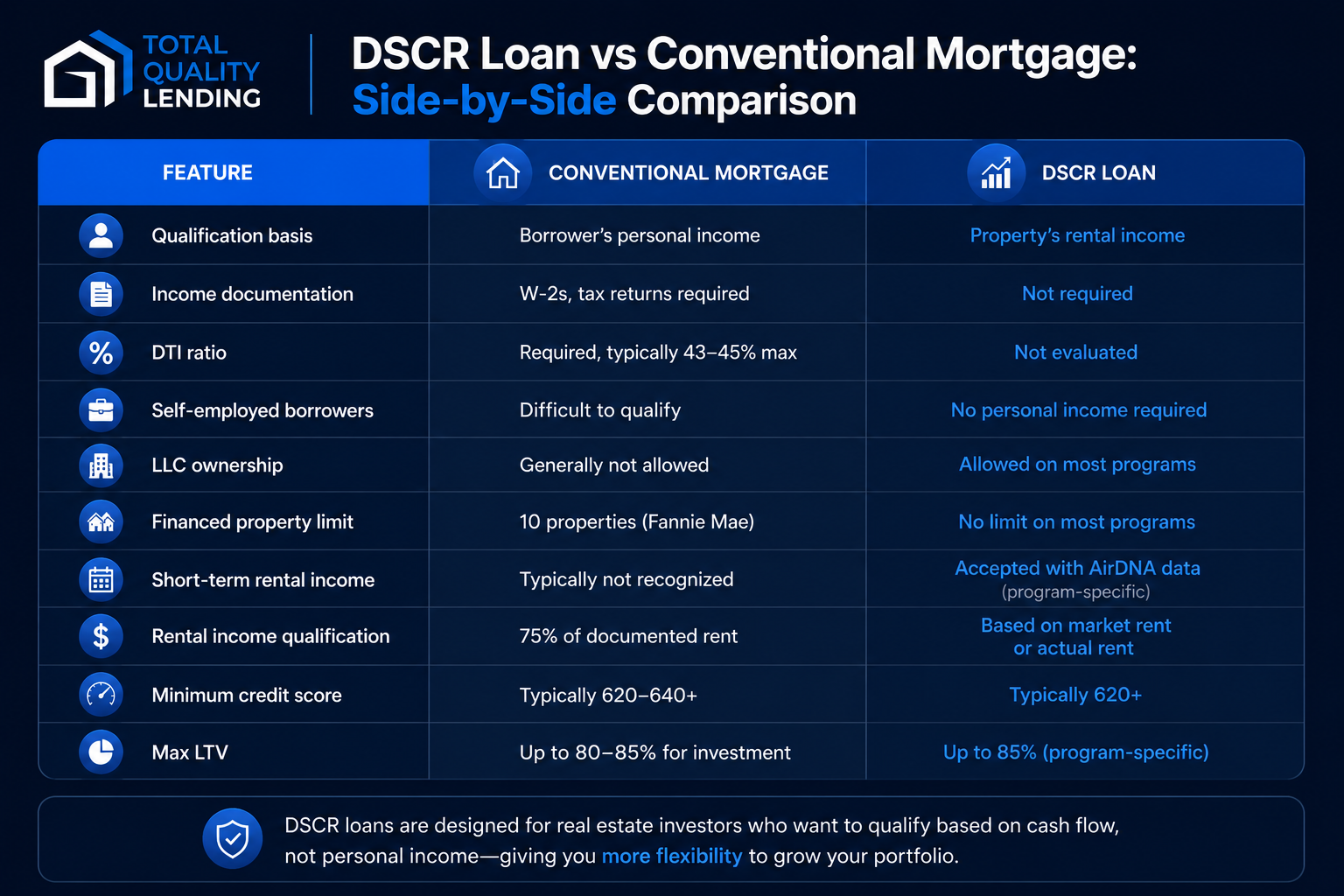
Side-by-side: DSCR vs Conventional Loan
| Feature | DSCR Loan | Conventional Loan |
|---|---|---|
| Income documentation | None — property's rental income qualifies | 2 years tax returns + W-2s + pay stubs |
| Maximum LTV (investment) | Up to 80% | Up to 75–80% (lower for 2nd+ investment) |
| Minimum credit score | 640 | 620 (higher for investment property) |
| Debt-to-income (DTI) limit | Not measured | Typically capped at 43–50% |
| Property count limit | Unlimited | 10 financed properties total |
| LLC vesting | Allowed | Not allowed (must be personal name) |
| Short-term rental (Airbnb) income | Counts up to 80% LTV | Often excluded or heavily discounted |
| Closing timeline | 15–21 days | 30–45 days |
| Foreign national borrowers | Eligible (FN DSCR program) | Not available |
| Rate (typical, 2026) | 0.75–1.5% above conventional | Lowest available |
DSCR vs Conventional Mortgage: Why Real Estate Investors Struggle to Get Funded
Most real estate investors hit the same wall at some point.
They find a property that makes sense. The numbers work. The rental income is strong. But when they go to get financing, the lender says no — or comes back with terms that kill the deal.
The problem usually isn't the investment. The problem is the loan product.
Conventional mortgages were not designed for real estate investors. They were designed for homebuyers. And when investors try to force their scenarios into a conventional mortgage framework, they run into qualification barriers that have nothing to do with whether the investment is actually sound.
DSCR loans were built to solve that problem.
This guide breaks down the core differences between DSCR loans and conventional mortgages — what they are, how they work, who qualifies, and why more real estate investors are choosing DSCR financing to grow their portfolios.
What Is a Conventional Mortgage?
A conventional mortgage is a home loan that meets the guidelines set by Fannie Mae or Freddie Mac — the two government-sponsored enterprises that purchase mortgages from lenders on the secondary market.
Because lenders plan to sell these loans to Fannie Mae or Freddie Mac, they must follow strict agency underwriting guidelines. Those guidelines are built around the assumption that the borrower is a homebuyer with W-2 employment income, consistent personal tax returns, and a debt-to-income ratio that falls within agency limits.
For a homebuyer purchasing a primary residence, conventional financing works well. For a real estate investor, it creates significant problems.
Why Conventional Mortgages Don't Work for Real Estate Investors
Conventional mortgage guidelines were designed for a specific borrower profile that most active real estate investors don't match. Here's where the friction typically occurs:
Debt-to-Income Ratio (DTI) Limits
Conventional loans require the borrower's total monthly debt payments — including all existing mortgages, car loans, student loans, and the new loan being applied for — to fall within agency DTI limits, typically 43–45%.
For investors who already hold multiple financed properties, DTI quickly becomes a disqualifying factor. Each property they own adds to their monthly debt obligations, even if those properties generate positive cash flow that more than covers the payment.
Personal Income Verification Requirements
Conventional loans require full income documentation — typically two years of W-2s or personal tax returns. For self-employed investors, this creates a compounding problem.
Self-employed borrowers often use legal tax strategies — depreciation, business deductions, cost segregation — that reduce their taxable income on paper. That lower taxable income may not reflect their actual financial position, but it's what conventional underwriters use to qualify the loan. The result is that a financially strong investor with substantial real estate holdings may not qualify for a conventional loan because their tax returns show insufficient income.
Fannie Mae Loan Limits on Financed Properties
Fannie Mae guidelines limit borrowers to a maximum of ten financed properties at one time. For active portfolio investors, this ceiling becomes a hard stop on growth — regardless of how well their existing properties perform.
Rental Income Limitations
When a conventional lender does allow rental income to count toward qualification, they typically apply a 75% vacancy factor and require documentation — existing leases, tax returns showing rental history, or appraisal-based rent schedules. Projected income from a new purchase rarely qualifies in full.
For short-term rental investors, the problem is worse. Conventional lenders typically don't recognize Airbnb or vacation rental income at all during the qualification process, even when market data clearly supports the projected revenue.
What Is a DSCR Loan?
A DSCR loan — Debt Service Coverage Ratio loan — is a type of investment property loan that qualifies the borrower based on the income generated by the property itself rather than the borrower's personal income.
DSCR stands for Debt Service Coverage Ratio. It is a simple calculation that measures whether a property's rental income is sufficient to cover its debt obligations.
The DSCR formula is:
DSCR = Gross Rental Income / Total Debt Service (PITIA)
PITIA includes principal, interest, taxes, insurance, and association dues.
A DSCR of 1.0 means the property's rental income exactly covers the monthly debt payment. A DSCR above 1.0 means the property generates more income than the debt costs. A DSCR below 1.0 means the rental income does not fully cover the debt payment.
Most DSCR lenders require a minimum DSCR of 1.0 to 1.25, though some programs allow ratios below 1.0 for qualifying borrowers.
How Does DSCR Loan Qualification Work?
DSCR loan underwriting focuses on the property's income, not the borrower's personal financial picture. This fundamentally changes the qualification process for real estate investors.
Instead of reviewing W-2s, personal tax returns, and debt-to-income ratios, a DSCR lender evaluates:
- The property's current or projected rental income
- The property's monthly debt service (PITIA)
- The resulting DSCR ratio
- The borrower's credit score
- The loan-to-value ratio (LTV)
- The property type and condition
Because personal income is not the primary qualifying factor, DSCR loans work for self-employed investors, investors with multiple financed properties, LLC borrowers, foreign nationals, and investors whose tax returns don't reflect their true financial position.
Who Should Use a DSCR Loan?
DSCR loans are particularly well-suited for:
Self-employed real estate investors who use legal tax strategies that reduce their reported income and make conventional qualification difficult.
Portfolio investors who already hold multiple financed properties and have hit conventional loan limits or DTI ceilings.
Short-term rental and Airbnb investors whose income is projected, seasonal, or not yet documented through historical tax returns.
LLC and entity borrowers who hold or want to hold properties in a business entity for liability protection.
Investors who want to scale quickly and need a financing solution that evaluates deals on their own merits rather than their relationship to the borrower's personal balance sheet.
What Are the Requirements for a DSCR Loan?
While DSCR loan requirements vary by lender and program, common baseline requirements include:
- Minimum DSCR: 1.0 to 1.25 (some programs allow below 1.0)
- Minimum credit score: Typically 620 FICO
- Maximum LTV: Up to 85% on qualifying purchase programs
- Property type: Single-family, 2–4 unit, condo, short-term rental, and some commercial property types
- Loan purpose: Purchase or cash-out refinance
- Entity vesting: LLC and other entity structures eligible on most programs
No personal income documentation, DTI calculation, or employment verification is required on most DSCR programs.
How Total Quality Lending Structures DSCR Financing for Investors
At Total Quality Lending, DSCR loans are one of the core financing tools we use to help real estate investors qualify for and close investment property deals that conventional lenders can't accommodate.
Our DSCR programs are designed for:
- Long-term rental properties
- Short-term rental and Airbnb properties (with AirDNA income support)
- BRRRR refinances (cash-out up to 80% post-rehab)
- LLC and entity borrowers
- Portfolio investors scaling across multiple markets
If you have an investment property scenario that hasn't fit conventional guidelines — or you want to understand whether a DSCR loan is the right tool for your next acquisition — we're happy to review it.
Submit a scenario or schedule a strategy call at tqltpo.totalqualitylending.com.
Total Quality Financial, Inc. | NMLS #1933377. This article is intended for informational and educational purposes only and is not a commitment to lend or extend credit. Loan programs, rates, terms, fees, and qualification requirements are subject to change without notice and are subject to underwriting approval. Not all applicants will qualify. Equal Housing Lender. For licensing information, visit www.nmlsconsumeraccess.org.